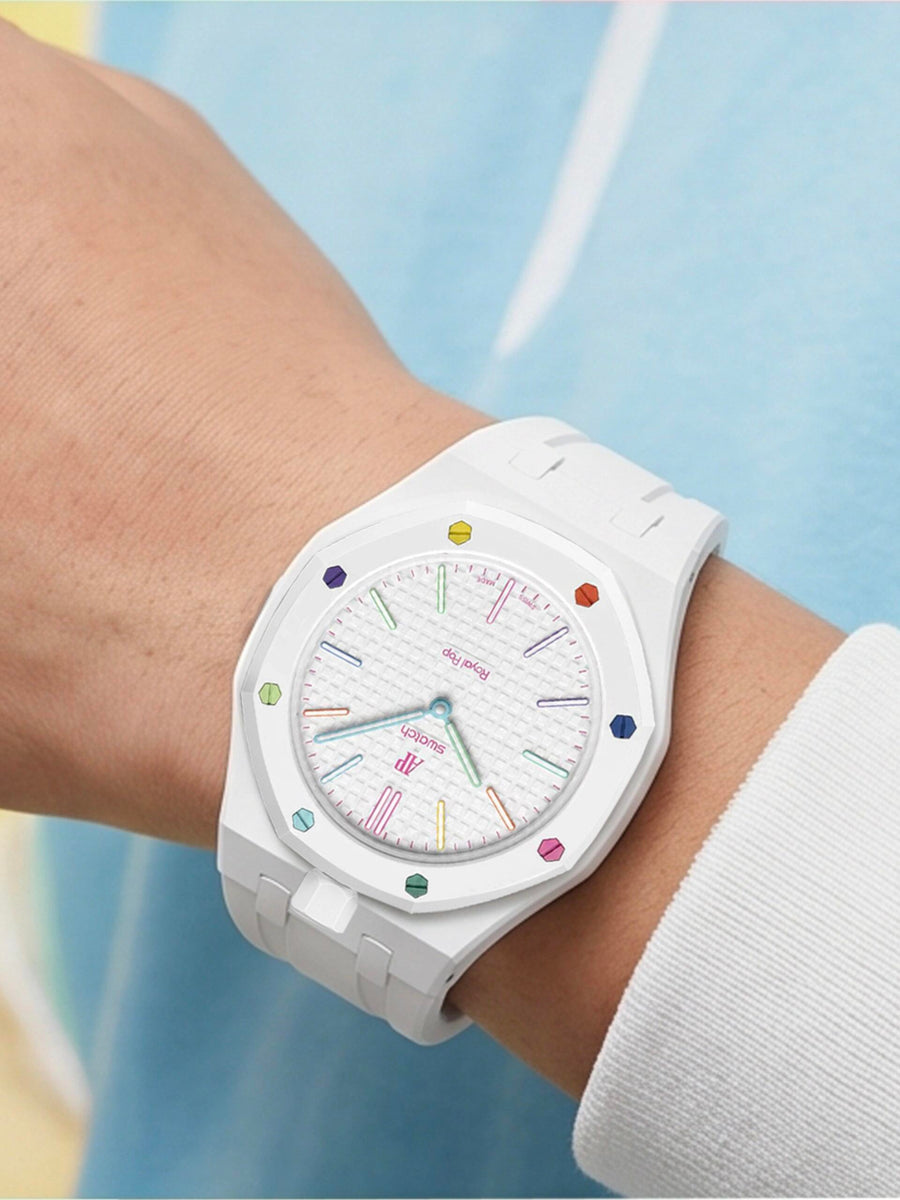
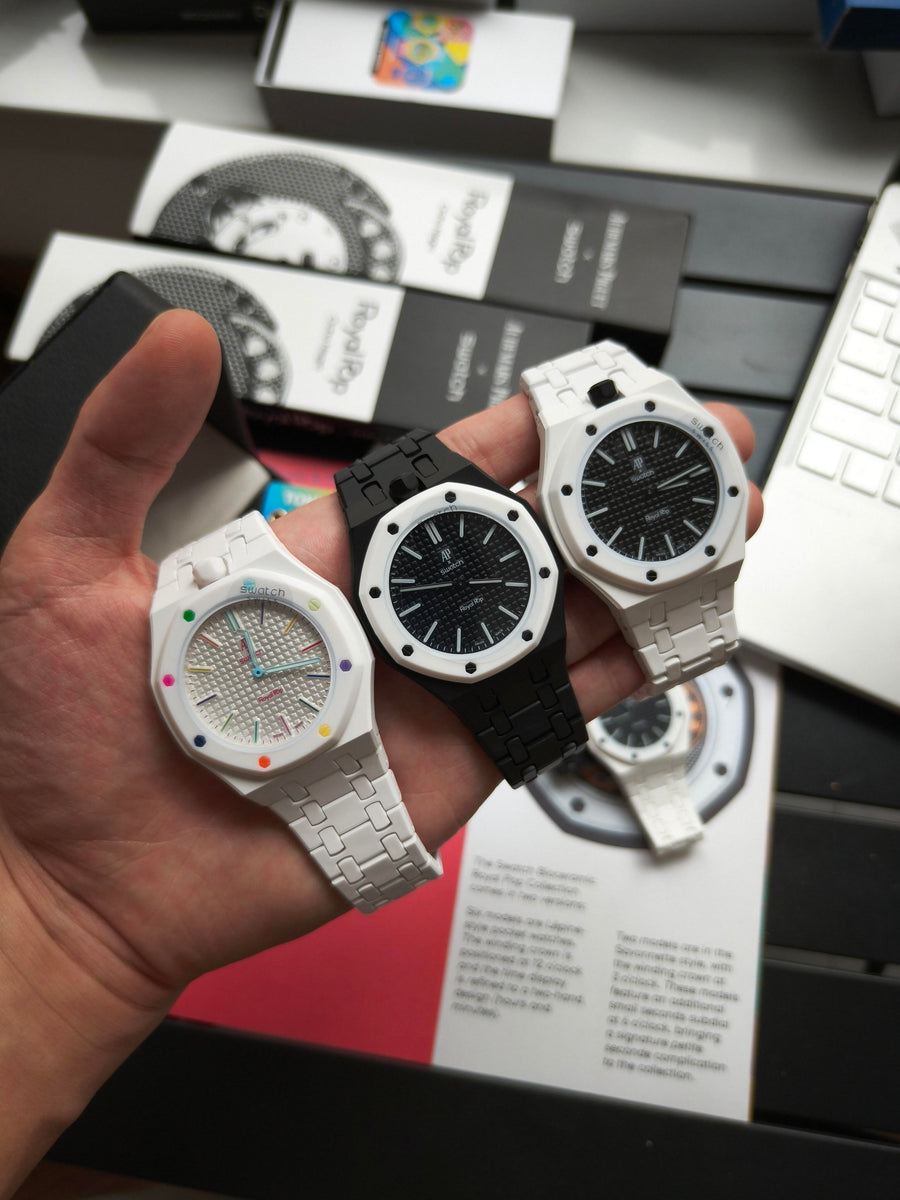
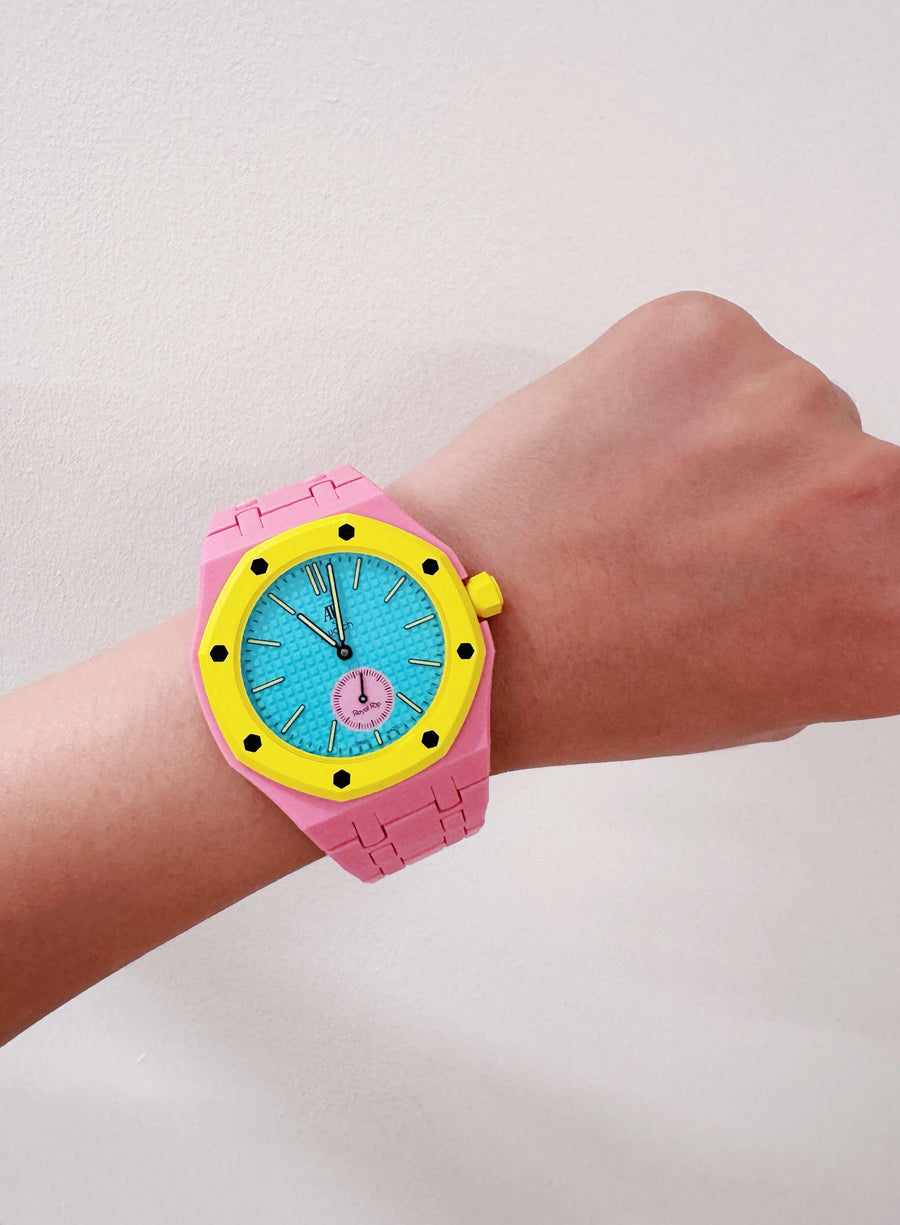
Will a Royal Pop Pop Out of a Conversion Strap?
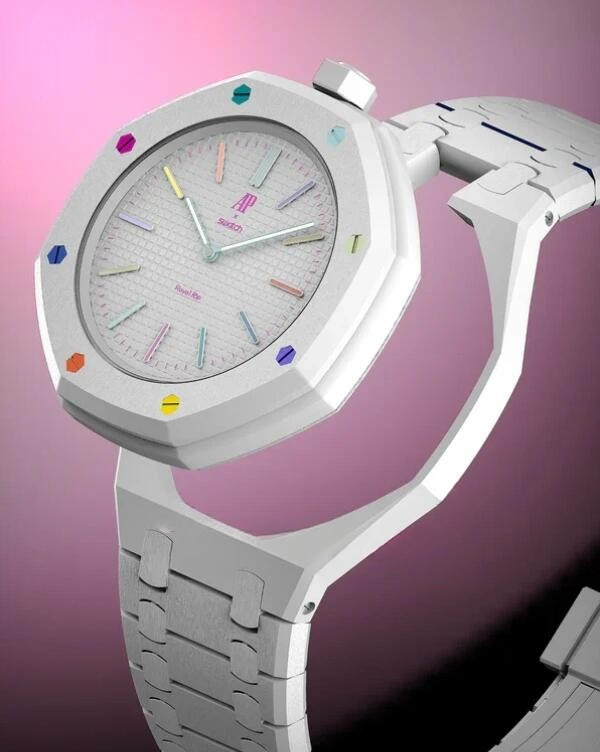
One of the most common questions about Royal Pop accessories has nothing to do with color, weight, or wrist presence.
It is much more practical:
Can the original Royal Pop move, wobble, or pop out of a conversion case while it is being worn?
This is a reasonable concern. A buyer is not only choosing a new visual style. They are placing the original watch inside a Royal Pop conversion strap and relying on that structure to remain stable during normal wrist movement.
A properly matched conversion case should hold the watch securely during ordinary daily wear when:
- the correct crown-position version is selected;
- the watch is inserted in the correct orientation;
- the watch reaches its intended seating depth;
- the internal contact surfaces align correctly;
- and the installation is checked before wearing.
However, “secure” should not be treated as an absolute promise that separation is impossible under every impact, accident, installation error, or extreme condition.
The more useful question is:
How can you tell whether the Royal Pop has been installed correctly and is sitting securely inside the conversion case?
What Does “No Wobble” Actually Mean?
When we describe a properly installed Royal Pop as having no wobble, we do not mean that every component has been compressed as tightly as physically possible.
A fit that is excessively tight can be just as concerning as one that is too loose.
“No wobble” means that, during normal handling and wrist movement:
- the watch does not visibly lift from one side of the conversion case;
- the watch does not rock forward and backward inside the housing;
- the watch does not shift laterally when light side pressure is applied;
- there is no repeated clicking caused by the watch moving between contact points;
- and the visible gap around the installed watch remains reasonably even.
A secure fit should feel stable rather than forced.
The goal is controlled mechanical retention: the watch is supported by the intended internal geometry of the case without glue, drilling, cutting, or permanent modification.
A small visual seam between components is not automatically a problem. What matters is whether that seam changes when the watch is lightly pressed or when the wrist moves.
By contrast, a watch that visibly tilts, lifts, clicks, or changes position under light pressure may not be fully seated.

What Keeps the Royal Pop Secure Inside the Case?
The watch is not kept in place simply because the opening looks tight from the front.
Retention depends on how the shape of the original watch interacts with the internal shape of the conversion case.
Several structural factors work together.
1. Full Seating Depth
The Royal Pop needs to enter the conversion case to its intended depth.
When it is fully seated, the watch is supported by more than the upper edge of the opening. The surrounding case geometry can engage the intended sides, lower surfaces, and supporting edges of the original watch.
If the watch remains partially raised, the setup may look almost correct from the front while still being less stable under wrist movement.
A partially seated installation can also produce an uneven side profile or a visible gap that is larger on one side than the other.
2. Internal Contact Surfaces
Inside a properly matched conversion case, certain surfaces are intended to support and locate the watch.
These contact areas help control movement in several directions:
- Vertical movement: the watch trying to lift outward;
- Lateral movement: the watch shifting from side to side;
- Rotational movement: the watch trying to turn inside the housing;
- Rocking movement: one side rising while the opposite side lowers.
A better retention design spreads support across multiple compatible surfaces instead of relying on one narrow pressure point.
This matters because concentrated pressure can make installation feel harsh, create uneven seating, or place unnecessary stress on a small area of the original watch.
The contact surfaces should support the watch without requiring glue or excessive compression.
3. Matching Internal Geometry
The original watch and the conversion case must match in orientation, crown position, dimensions, and internal shape.
A Royal Pop with a crown at 12 o’clock should be paired with the corresponding 12 o’clock conversion case. A crown-at-3 configuration should use the matching 3 o’clock version.
Choosing the wrong version can prevent full seating even when the watch appears close to fitting.
The correct match allows the case opening, internal supports, crown clearance, and surrounding structure to work together as intended.
Before ordering, review the Royal Pop compatibility and installation FAQ and confirm the crown position shown on your original watch.
4. Strap and Case Structure
The strap or bracelet should support the conversion case without twisting it unnaturally.
During normal wear, the two sides of the strap apply changing angles to the case as the wrist bends. A correctly assembled setup should maintain the watch’s seated position during those ordinary movements.
This is why a conversion case should be evaluated on the wrist, not only while lying flat on a table.
Fully Installed vs Not Fully Installed
A Royal Pop can appear centered from the front while still not being completely seated.
For that reason, the best installation comparison should include both front and side views.
Signs of a Correctly Seated Installation
A properly installed Royal Pop will generally show:
- a consistent position within the case opening;
- an even relationship between the watch and surrounding bezel;
- no clearly raised corner or side;
- no visible change when light pressure is applied;
- correct crown clearance;
- and stable positioning during gentle wrist movement.
The watch should feel integrated with the conversion case rather than balanced loosely on top of it.
Signs That the Watch May Not Be Fully Seated
Stop and recheck the installation if you notice:
- one side sitting visibly higher than the other;
- an uneven or unusually large gap;
- movement when alternating light pressure between two sides;
- a clicking sensation during light handling;
- incorrect crown alignment;
- resistance caused by the watch entering at an angle;
- or the watch returning upward after being pressed into position.
Do not solve an incomplete installation by applying excessive force.
Remove the watch carefully, confirm crown-position compatibility, inspect the orientation, check for debris, and repeat the installation according to the instructions for the specific conversion kit.

Four Simple Tests After Installation
After installing the Royal Pop, perform the following four checks before wearing it normally.
These are light, practical checks intended to identify an obvious installation problem. They are not destructive product tests and should not involve excessive pressure, hard shaking, dropping, twisting, or impact.
Perform the checks above a folded towel or another soft surface.
Test 1: Light Front-Pressure Test
Support the conversion case from underneath.
Using a fingertip, apply light and even pressure around the outer edge of the installed watch. Avoid pressing heavily on the crystal.
Check whether:
- one side lowers more than the other;
- the watch rocks inside the case;
- a gap opens on the opposite side;
- or the watch produces a repeated click.
A correctly seated watch should remain in substantially the same position under light pressure.
This test is not about forcing the watch farther into the case. It is only intended to identify visible movement.
Test 2: Light Side-Pressure Test
Hold the case securely and apply gentle lateral pressure from one side, followed by the opposite side.
The watch should not noticeably slide across the opening or change its alignment with the bezel.
A slight amount of material compliance is different from the watch itself moving inside the housing. Focus on whether the position of the original watch changes relative to the conversion case.
If the watch shifts, clicks, or tilts, remove it and recheck the installation.
Test 3: Wrist-Flex Test
Put the assembled setup on your wrist and fasten the strap or bracelet normally.
Slowly:
- bend the wrist upward;
- bend it downward;
- rotate the wrist;
- and move the hand through an ordinary wearing range.
Observe the case from the front and side.
The installed watch should remain seated as the strap angle changes. There should be no lifting edge, sudden click, or visible change in the gap.
This test is important because a setup that appears stable on a table can behave differently once the strap begins applying changing angles around the wrist.
Test 4: Gentle Shake Test
Remove the watch from your wrist and hold the assembled strap securely over a folded towel.
Give it one or two gentle, controlled movements similar to the motion it might experience during normal handling.
Do not whip, throw, strike, or violently shake the watch.
Listen and look for:
- internal clicking;
- visible lifting;
- movement between the watch and case;
- or any change in seating position.
A properly installed watch should remain stable during this light check.
Passing these four checks does not certify the setup for impacts or extreme use. It simply helps confirm that there is no obvious movement following installation.
Why Mechanical Retention Matters More Than Glue
A reversible Royal Pop conversion should not need glue, drilling, grinding, or permanent alteration of the original watch.
Glue-based retention creates several potential problems:
- adhesive can weaken over time;
- alignment mistakes are harder to correct;
- removal becomes less predictable;
- residue may remain on the original watch;
- and the installation is no longer genuinely reversible.
Mechanical retention is easier for a buyer to understand and inspect.
The watch is held by compatible dimensions, insertion depth, supporting surfaces, and case geometry rather than by a hidden adhesive bond.
This does not mean that every mechanically retained accessory is automatically secure. The fit still depends on correct compatibility, manufacturing tolerances, installation, wear, damage, and condition.
However, a no-glue structure gives the owner a clearer way to inspect whether the watch is properly seated.
Steel vs Bioceramic-Style Cases: How Does the Retention Logic Differ?
Both the Stainless Steel Royal Pop conversion kit and the Bioceramic-style Royal Pop conversion kit are intended to create a reversible wristwatch-style setup without glue or permanent modification.
However, steel and Bioceramic-style materials behave differently, so the way a secure fit feels may not be identical.
Stainless Steel Conversion Case
A stainless steel case has a more rigid and structurally solid feel.
Because the housing flexes less, the retention experience depends heavily on:
- precise internal dimensions;
- correct alignment during insertion;
- even contact between the original watch and supporting surfaces;
- and the watch reaching the correct seating depth.
A steel setup may feel more defined during installation. The difference between aligned and misaligned insertion can be easier to notice because the surrounding structure is less flexible.
Do not interpret strong resistance as proof of a more secure fit. If the watch does not enter in a controlled and even way, stop and check the orientation rather than applying more force.
Bioceramic-Style Conversion Case
A Bioceramic-style case provides a lighter wearing experience and may show different material compliance from a steel housing.
Its retention should still come from the shape and geometry of the case—not from simply squeezing the watch as tightly as possible.
When checking a Bioceramic-style setup, pay particular attention to:
- whether the watch is seated evenly;
- whether any side remains raised;
- whether the visible gap changes under light pressure;
- and whether the watch itself moves independently from the surrounding case.
A small amount of response from the surrounding material should not automatically be confused with internal wobble. The key question is whether the original watch changes position inside the housing.
The Shared Retention Principle
Despite the material differences, both setups should follow the same basic logic:
- Choose the correct compatible version.
- Align the watch correctly.
- Seat it to the intended depth.
- Confirm even support around the housing.
- Check for movement before wearing.
Steel relies more visibly on rigid dimensional alignment, while a Bioceramic-style housing may feel slightly different because of its material behavior.
Neither material should rely on glue, and neither should require excessive force to compensate for incorrect installation.
For a broader material and wearing comparison, read Stainless Steel vs Bioceramic Royal Pop Accessories.
Can the Conversion Case Scratch or Pressure the Original Watch?
Any accessory that contacts the surface of a watch must be installed carefully.
The risk depends on factors including:
- the accuracy of the fit;
- the cleanliness of the watch and conversion case;
- the condition of the contact surfaces;
- the insertion angle;
- and whether excessive force is used.
Before installation, inspect both the original watch and the inside of the conversion case.
Remove visible dust, grit, metal particles, or other debris. Even a well-designed contact surface can cause marking if hard debris becomes trapped between the two components.
During installation:
- do not twist the watch aggressively;
- do not use metal tools against visible surfaces;
- do not pry against the crystal or crown;
- and do not continue pressing if the watch is entering unevenly.
A secure installation should be controlled and repeatable rather than improvised.
When Should You Stop Wearing the Setup?
Remove and inspect the watch if you notice any change after installation, including:
- new wobble or clicking;
- a raised side that was previously flush;
- a larger or uneven gap;
- movement after an impact;
- cracking, deformation, or damage to the conversion case;
- loose strap or bracelet hardware;
- or unusual resistance around the crown.
The setup should also be rechecked after:
- dropping the watch;
- striking it against a hard surface;
- changing the strap or bracelet;
- removing and reinstalling the original watch;
- or exposing the case to unusual heat, chemicals, or physical stress.
Do not continue wearing a conversion case that appears damaged or no longer holds the watch in its original seated position.
What to Check Before Buying a Royal Pop Conversion Strap
Before ordering, confirm the following information.
Crown Position
Determine whether your Royal Pop has its crown at 12 o’clock or 3 o’clock when the dial is upright.
Select the matching conversion case.
Installation Method
Confirm that the setup does not require glue, drilling, cutting, or permanent modification.
Included Components
Check whether the listing includes:
- the conversion case;
- the selected rubber strap or bracelet;
- clasp or buckle components;
- and any installation accessories.
The original Royal Pop watch is not included with the conversion kit.
Real Product Images
Look for front, side, back, and wrist images.
For a fit-sensitive product, close-up photographs are more useful than front-facing renders alone.
Removal Method
A reversible setup should also have a controlled removal process.
Avoid forcing the watch out with sharp objects or prying against sensitive surfaces.
Strap and Bracelet Configuration
Fit is only one part of the buying decision. You should also decide whether you prefer the flexibility of a rubber strap, the structure of a steel bracelet, or the lighter appearance of a Bioceramic-style setup.
Our Royal Pop strap, case and bracelet upgrade guide compares these configurations for daily wear, summer use, travel, comfort, and wrist presence.
A Practical Installation Checklist
Before wearing the completed setup, confirm:
- The crown position matches the selected case.
- The watch is installed in the correct orientation.
- No debris is trapped inside the conversion case.
- The watch sits at an even depth.
- No edge remains visibly raised.
- Light front pressure does not cause rocking.
- Light side pressure does not cause shifting.
- Wrist flex does not change the seating position.
- A gentle handling test produces no movement or clicking.
- The strap, bracelet, buckle, clasp, and connecting hardware are secure.
- The case has no visible cracks, deformation, or damage.
If any item cannot be confirmed, remove the watch and inspect the installation before wearing it.
Important Safety and Use Limitation
A properly installed and correctly matched Royal Pop conversion case is designed to remain stable during normal everyday wear.
However, no responsible seller can promise that a watch will never separate under every possible condition.
Retention can be affected by:
- incorrect installation;
- an incompatible crown-position version;
- manufacturing variation;
- wear or damage;
- loose strap hardware;
- accidental impact;
- dropping the watch;
- extreme shaking or pulling;
- deformation of the case;
- exposure to unsuitable temperatures or chemicals;
- or use during activities beyond ordinary daily wear.
The four checks described in this guide are basic fit checks. They are not certifications for sports, impact, water use, occupational hazards, or extreme conditions.
Do not intentionally perform drop tests, violent shake tests, pull tests, or impact tests with the original watch installed.
Inspect the setup regularly, especially after an impact or reinstallation. If the fit changes or any component appears damaged, stop wearing it until the cause has been identified.
Frequently Asked Questions
What does “no wobble” mean in a Royal Pop conversion case?
“No wobble” means that the original watch does not visibly rock, lift, slide, rotate, or click inside the conversion case during light handling and normal wrist movement.
It does not mean that the watch has been forced into the case under extreme pressure.
Should the Royal Pop move when I press the front?
The watch should remain substantially stable when light, even pressure is applied around its outer edge.
If one side lowers, another side lifts, or the watch repeatedly clicks, it may not be fully seated.
Is a steel conversion case more secure than a Bioceramic-style case?
Material alone does not determine whether the watch is secure.
Steel provides a more rigid housing, while a Bioceramic-style case may have a different level of material compliance. Both still depend on correct compatibility, internal geometry, full seating depth, and proper installation.
Can I use glue to make the watch more secure?
Glue is not recommended for a reversible conversion setup.
It can leave residue, make alignment mistakes harder to correct, complicate removal, and permanently change the original watch or accessory.
Does passing the four tests guarantee the watch cannot fall out?
No.
The four tests help identify obvious installation problems under light, controlled conditions. They cannot guarantee retention during severe impact, accidental damage, violent movement, incorrect use, or every other possible situation.
Where can I compare different Royal Pop wrist straps?
Read our Royal Pop wrist strap fit guide for more information about strap comfort, case compatibility, adjustment, and reversible wristwatch setups.
The Bottom Line: Will a Royal Pop Pop Out?
A properly matched Royal Pop should remain stable in a well-designed conversion case when it is fully seated, correctly installed, and used under normal daily-wear conditions.
“No wobble” means the original watch does not rock, lift, shift, or click inside the housing during light handling and ordinary wrist movement.
The best way to build confidence is not to rely on a broad claim such as “it can never fall out.” Instead, check the details that can actually be inspected:
- correct crown-position compatibility;
- full seating depth;
- even internal support;
- no visible movement;
- stable behavior during wrist flex;
- and a reversible, no-glue installation method.
Review the installation and compatibility FAQ, then compare the Steel Conversion Kit and Bioceramic Conversion Kit based on fit, material, weight, and how you plan to wear the watch.
Disclaimer: RoyalPop Accessories produces independent aftermarket accessories for compatible watches. RoyalPop Accessories is not affiliated with, endorsed by, sponsored by, or produced by Swatch, Audemars Piguet, or any related original watch manufacturer. The original watch is not included. Product compatibility, correct installation, regular inspection, and appropriate use remain the responsibility of the owner.
Explore RoyalPop Accessories
Product, compatibility, and brand information.
Explore RoyalPop Accessories
Product, compatibility, and brand information.
RoyalPop Accessories is independent and is not affiliated with, endorsed by, or sponsored by any original watch brand.